Democratic Party leader and former President Sali Berisha injured during clashes.
Tirana Times, March 22, 2026 — Albania’s latest national opposition protest in Tirana, which ended in violent clashes between protesters and police, exposed not only rising anger against Prime Minister Edi Rama’s government but also a broader crisis of legitimacy surrounding his fourth term. Tens of thousands of demonstrators confronted police and attacked government-related targets with Molotov cocktails, fireworks, flares and other pyrotechnic devices, while police responded with tear gas and water cannons. Clashes spread from the Prime Minister’s Office to the AKSHI building, the Tirana Municipality, nearby ministries and the headquarters of the ruling Socialist Party. Democratic Party leader and former President Sali Berisha was reportedly injured during the police intervention.
The opposition says the protest was driven by more than immediate anger. Its core demands are the resignation of the prime minister and the government, and the creation of a technical caretaker government to prepare new elections. The Democratic Party, the main opposition force, accuses Rama of building not simply an increasingly centralized system of rule, but a regime and a “narco-state” in which, in its view, power, state institutions, corruption networks and criminal interests have become inseparable.
At the center of this argument is the claim that Rama secured a fourth mandate by stealing the elections. According to the opposition, and as it argues has also been reflected in international reporting and independent expert assessments, the state with all its human, administrative and financial resources was deployed against the opposition during the electoral process. In that sense, the protest was not only against the government’s current policies, but against what the opposition sees as the destruction of elections as a credible instrument of democratic rotation. In Albania, contested elections have long been a recurring source of instability, and the opposition now argues that this pattern has reached a far more dangerous level.
The political background to the protest is equally important. Within just a month of beginning his fourth term, Rama was forced into major government reshuffles, dismissing the deputy prime minister and minister of infrastructure and energy, against whom the Special Prosecution against Organized Crime and Corruption had sought arrest. One week earlier, however, the parliament controlled by the ruling majority refused SPAK’s request to lift Belinda Balluku’s immunity, a decision that would have opened the way to her arrest. The opposition claims that by protecting Balluku, Rama is in fact protecting himself, arguing that shielding his closest associate from prison is also a way to prevent the investigation from politically and personally reaching the prime minister.
The reshuffle itself fed perceptions of deeper crisis. More than half of the government was changed, including the foreign minister, in moves interpreted by critics as evidence of mistrust, internal fracture and an attempt to contain political and legal fallout rather than enact genuine renewal.
For the opposition, this pressure comes from an expanding chain of corruption scandals. Albania has been hit by a series of major corruption affairs, while critics argue that the distinction between oligarchic networks, organized crime and the government has become increasingly blurred. A significant number of senior officials are already in prison, under investigation, or convicted. Former deputy prime minister Arben Ahmetaj remains internationally wanted, former deputy prime minister Balluku is seen by critics as being on the verge of arrest, the former mayor of the capital is in prison, and former ministers of health and environment, along with dozens of other senior officials, have faced prosecution or scrutiny. Another sensitive file, according to sources cited by critics, concerns AKSHI, where prosecutors announced the dismantling of a structured criminal group.
This opposition narrative goes further, linking political power to illicit economic flows. Drug trafficking, critics argue, has helped sustain power through the construction industry, which they describe as a central channel for laundering criminal proceeds, especially in Tirana and along the coast.
These accusations are now colliding with Albania’s European ambitions. According to opposition and independent critical voices, the use of parliamentary immunity as a barrier against justice has triggered alarm in the European Union and in several member states. Four days before the protest, the European Council approved further progress in the integration process only for Montenegro, not for Albania. Independent experts interpret this as a negative signal and argue that Rama’s government has effectively closed the door on Albania’s own integration path.
The domestic cost, critics argue, is already visible. Over the past decade, more than 900,000 citizens are said to have left Albania, while about 90 percent of young people are reported to be ready to emigrate. For the opposition, this is the social consequence of a political system that is suffocating the country’s future. As former Democratic Party lawmaker Genc Pollo put it, “This is a regime that is suffocating the country and its future.”
Speaking after the clashes, Berisha praised the protesters and escalated his rhetoric against the government, framing the moment as a decisive confrontation. “This was a magnificent battle and I guarantee the next will be even more magnificent, and for Edi Rama there will be no shelter, no mouse hole where he can hide,” he said. He added that “the peaceful uprising of Albanians will deliver the punishment they deserve,” and warned the prime minister to resign, declaring: “Edi Rama, resign as soon as possible. Resign, because we will bring you down in a way you cannot imagine.”
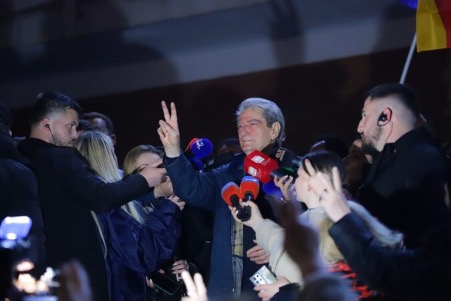
Berisha also linked the protest directly to corruption and the use of power for personal gain, accusing the ruling elite of “stealing public wealth like hyenas” and using laws and mandates “to protect their theft.” He told supporters that “there can be no peace in this country with those who steal and enrich themselves,” adding that those responsible “will end up in the dustbin of history.”
The symbolic meaning of the protest was reinforced by its date. March 22 was chosen deliberately to coincide with the anniversary of the 1992 elections, when the Democratic Party won Albania’s first pluralist vote and ended communist rule. By organizing the protest on that day, the opposition sought to present today’s confrontation not as an ordinary partisan battle, but as a new struggle against what it sees as an entrenched system of power that once again threatens political pluralism itself.
The post Albania Opposition Protest Turns Violent appeared first on Tirana Times.