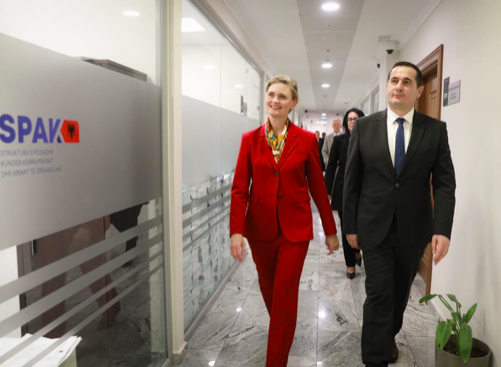
The United States has once again issued an unusually clear and public warning about the threat posed by Albanian organized crime groups and their links to Latin American drug cartels, framing the issue not only as a criminal challenge but as a direct risk to Albania’s national security and economic future.The message was delivered by Nancy VanHorn, the U.S. Chargé d’Affaires in Tirana, in remarks published by the American embassy following a training program led by the Federal Bureau of Investigation for investigators from SPAK and the National Bureau of Investigation. Her warning reiterated a concern that Washington has raised repeatedly: Albanian criminal networks cooperating with Latin American cartels are undermining the rule of law, enabling large-scale money laundering, and threatening the country’s long-term stability.

VanHorn stressed that these networks profit from drug trafficking and financial crimes facilitated by modern technologies, and she made clear that fighting organized crime and narcotics trafficking remains a top U.S. priority in Albania. She underlined continued American support for SPAK, the National Bureau of Investigation, and security training institutions, aligning these efforts with the priorities of the Trump administration.
This warning was not an isolated message. On Albania’s Independence Day, U.S. Secretary of State Marco Rubio explicitly linked bilateral cooperation with Albanian law enforcement to confronting international criminal groups and drug cartels, noting that such cooperation enhances security for both countries. The repetition and consistency of these messages point to a deeper concern in Washington: that organized crime in Albania is not merely a policing issue, but one intertwined with politics, economic policy, and institutional weakness.
Local analysts interpret the American statements as an implicit reference to the nexus between crime and politics. Political scientist Ermal Hasimja has argued that Albanian traffickers operating in Latin America would not feature so prominently in U.S. discourse without having strong domestic bases and political protection at home. Afrim Krasniqi, head of the Institute for Political Studies, has similarly noted that Washington has raised these concerns multiple times, particularly after the U.S. imposed expanded sanctions on an Albanian criminal family accused of laundering international drug profits through complex business networks spanning Mexico, Canada, and Europe.
Krasniqi points out that, in a functioning rule-of-law state, such sanctions should trigger immediate domestic investigations into the origins of capital, the scale of investments, and the beneficiaries of public funds. Instead, individuals sanctioned by the United States continue to operate in Albania, benefiting from public contracts and investing heavily in construction and tourism, with no serious scrutiny of their financial sources.
This is where the contrast between the United States and the European Union becomes politically significant. While the U.S. Embassy in Tirana has repeatedly sent unambiguous messages about the links between organized crime, drug trafficking, money laundering, and Albania’s national security, the EU Delegation and the embassies of EU member states in Tirana have largely remained silent, despite mounting evidence that the country is turning into a major hub for laundering proceeds of crime, corruption, and international narcotics trafficking.
Independent experts describe this silence as increasingly indefensible. Turning a blind eye to Albania’s massive construction boom, at a time when credible evidence suggests that large segments of the sector are fueled by illicit capital, raises fundamental questions about Europe’s commitment to the rule of law in an EU-aspiring, NATO-member state. The legalization of informal capital through repeated amnesties, critics argue, normalizes criminal wealth, distorts market competition, and entrenches the influence of criminal networks over politics, media, and public life.
As Krasniqi warns, no country can become democratic or economically sustainable if its growth is driven by money from drugs, trafficking, and corruption. Allowing luxury resorts, high-rise towers, and flagship investments to be financed by illicit capital creates a negative legacy for future generations, undermines fair competition, and makes political institutions increasingly vulnerable to criminal pressure.
Washington’s message, therefore, is not only a warning to criminal groups but a test for Albania’s partners. While the United States speaks openly about the risks, Europe’s continued reluctance to confront these realities risks sending the opposite signal: that strategic silence is preferable to uncomfortable truths. For a country seeking EU membership, that contradiction may prove more damaging than any single criminal network.
Courtesy of Blerina Gjoka and Reporter.al
The post America’s Warning on Drug Cartels: Why Europe’s Silence in Albania Matters appeared first on Tirana Times.