Six years after the killing of Klodian Rasha, the protests of October 2026 have brought allegations of police violence, arbitrary detentions and rights violations back into focus. Documents and testimonies reveal that the same problems are recurring, while the institutions have yet to give full answers on the investigation and punishment of the officers responsible.
by Lindita Cela
TIRANA, Albania – Minors who claim they were subjected to police violence, citizens who report being arbitrarily detained by officers without identification numbers, and people held in premises where they were forced to sleep on the floor. These are not only testimonies and footage broadcast during the October protests, but also findings documented by the People’s Advocate (Ombudsman).
In just 72 hours of monitoring, the institution recorded 214 people deprived of their liberty, and for 26 of them it noted in its official records allegations of violence and physical marks that had been observed. In later monitoring, five of the eight minors held at Police Commissariat No. 1 in Tirana claimed they had been physically and verbally abused, while two of them had signs of injury.
Minors questioned without a parent or a psychologist present, officers without identification numbers, allegations that mobile phones were searched, and premises where the number of detainees far exceeded capacity. These are some of the findings that shed light on how the police acted during the protests.
Meanwhile, dozens of criminal complaints have been filed with the Tirana Prosecutor’s Office by injured protesters and their families. More than 180 suspected episodes of police violations have also been included in a complaint filed with the Special Prosecution Office.
The repeated reports, the complaints lodged with the police oversight bodies and the criticism from the European Commission show that cases of violence and of officers exceeding their powers are not isolated episodes. They point to shortcomings in the training of officers, but also in the mechanisms for oversight, accountability and the punishment of violations, creating a climate in which the abuse of police authority is repeated without visible consequences for those responsible.
When violence wears the uniform of the State Police
Credits: Ergin Zaloshnja
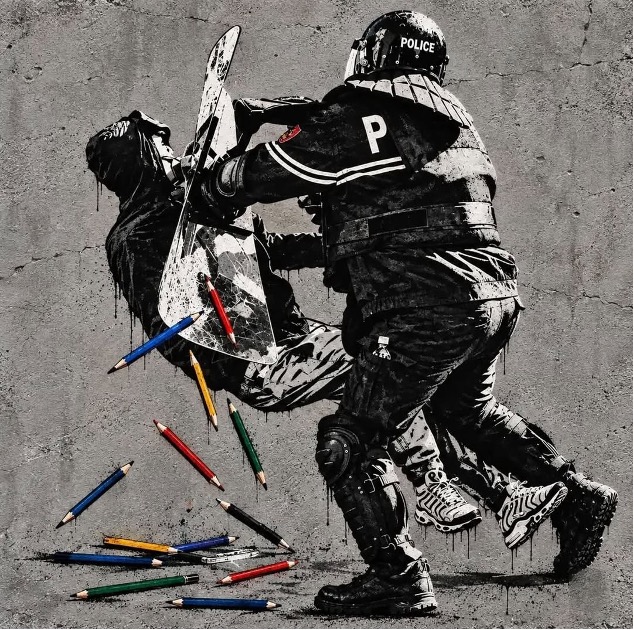
On the fourth day of the protests, in front of the Ministry of Education, Muhamet Skana, just 21 years old, stood facing the police cordon. Dressed in grey tracksuit bottoms and a dark hooded top, with his arms hanging at his sides, the young man did not appear to pose any threat to the officers facing the protesters.
Video footage, which spread across social media within minutes, shows an officer breaking away from the police cordon, running towards the 21-year-old and striking him with a shield. The blow sends the young man crashing head first onto the asphalt.
According to the complaint filed with the prosecutor’s office, family members state that, after he had been knocked to the ground, officers also hit him with rubber batons. They claim the blows caused injuries to his skull and a crack in his spinal column but that, despite his condition, the young man was not taken immediately to the Trauma Hospital.
For around three hours, Ardi remained on police premises and, according to his family, medical help was sought only after they intervened.
Medical documents show that the young man had suffered a fracture of the skull and of the third vertebra, muscle injuries and haematomas on his body, and that Ardi did not remember what had happened during the collision with the officer, as a result of temporary memory loss. Even after his condition stabilised and doctors assessed that the danger to his life had passed, he could not walk normally because of the injuries he had sustained.
The footage of the blow became one of the most discussed episodes of the October protests. The prosecutor’s office and the Police Oversight Agency opened investigations. Minister Ervin Demo announced the suspension from duty of the officer who had struck the young man.
This is not the only complaint lodged after the protests. Dozens of individual criminal complaints have been filed with the Tirana Prosecutor’s Office by injured protesters or their families. Meanwhile, the complaints filed with the Special Prosecution Office include more than 180 suspected episodes of police violence and violations.
The complaints call for an investigation of the suspected officers, but also of the chain of command, to determine whether responsibility is limited to the individuals who appear in the footage or also extends to the orders and to the way the interventions were organised.
For lawyer Irena Dule, the matter does not end with the blow in the street. She stresses that the police have a legal obligation to guarantee the health and physical integrity of every person they hold under their control, and that failure to do so can lead to criminal liability.
“The police have an obligation to guarantee the health and physical integrity of every person they hold under their control. When a person is injured, medical help must be provided immediately. Failure to meet this obligation can lead to disciplinary and criminal liability, depending on the circumstances and the consequences,” says Dule.
The image of the 21-year-old lying on the asphalt, the tear gas, the rubber batons and the footage of police officers chasing citizens through the streets brought back the scenes of the clashes of December 2020. Back then, a 25-year-old was killed with the service weapon of a police officer, and his death brought thousands of people onto the streets. The documents from the two events also raise questions about the responsibility of officers and the enforcement of the law on assemblies, particularly in cases of violations by the police.
The “Eagles” step outside their mission
Credits: Koha Jonë
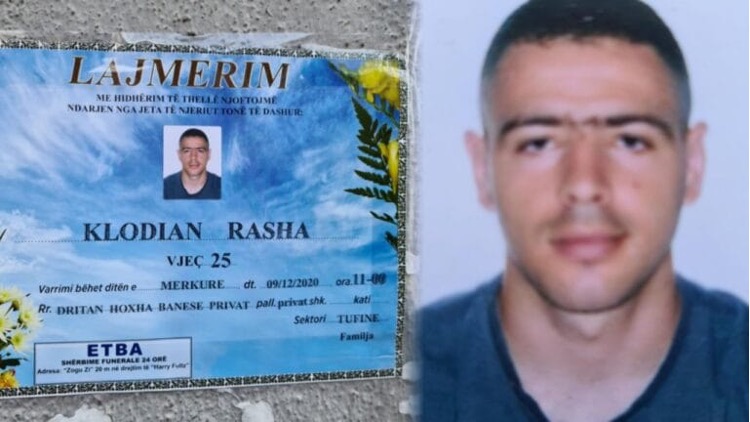
In the early hours of 8 December 2020, while Tirana was under movement restrictions because of the COVID-19 pandemic, Klodian Rasha was spotted by two police officers on patrol in “Dritan Hoxha” street.
His failure to obey the order to stop was followed by a chase through the alleys of the capital. During the chase, two shots were fired at Rasha. The first bullet hit the shutter of a shop; the second went through his back and damaged his heart. Rasha was killed a few metres from his home.
Officer Nevaldo Hajdaraj was found guilty of the killing and initially sentenced to 12 years in prison, but Rasha’s death was followed by a wave of protests across the country. The protesters demanded justice for Rasha, but also political and institutional accountability for the way the police functioned. The then Interior Minister, Sandër Lleshaj, resigned.
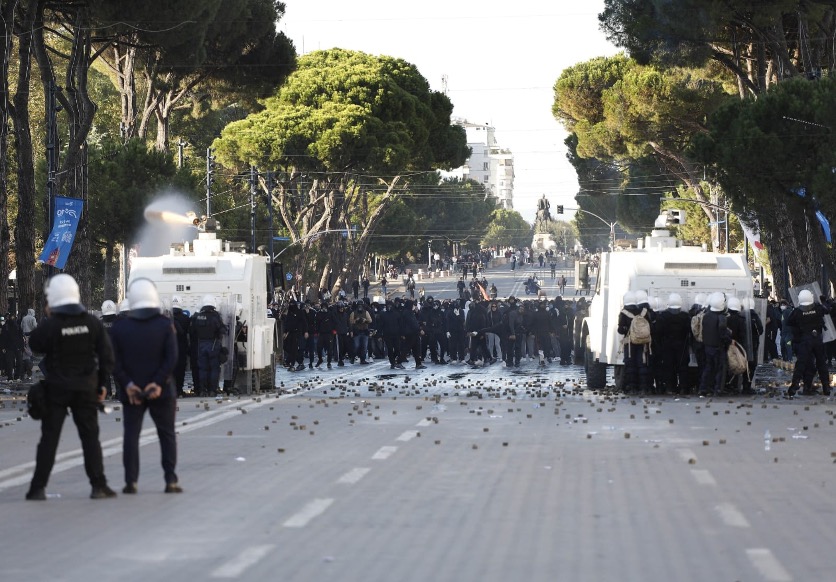
In the days that followed, clashes between protesters and police were accompanied by the use of tear gas, water cannon and mass detentions. According to official data, between 10 and 14 December 2020, 100 people were arrested, 387 were prosecuted without being held in custody and 10 others were declared wanted. The People’s Advocate reported that by 13 December, 102 minors had been taken to police stations in Tirana.
The concerns were not only about the number of people detained. Citizens and legal representatives raised allegations that people who had not taken part in the protests were detained, that violence was used during detention and on police premises, and that procedural safeguards for minors were violated.
Lawyer Irena Dule, who represented one of the protesters facing criminal proceedings and also followed other cases from that period, recalls that the problems began in the street but did not end when citizens arrived at the police station.
“During the protests of December 2020, the main problems were mass detentions, often without individualising the actions of the protesters, allegations of physical violence during detention and on police premises, and the violation of procedural safeguards, especially for minors,” she says.
The People’s Advocate also documented problems in the handling of the December protests. In its annual report for 2021, the institution identified cases in which tear gas was used without warning and water cannon was used disproportionately, including against passers-by. It recommended identifying the officers responsible, opening disciplinary proceedings and providing continuous training for the police on managing assemblies.
The recommendations of six years ago identified precisely the same problems reported during the protests of October 2026: the use of force, the identification of officers, training in crowd management and accountability for violations.
“The number of documented cases, the similarity in the way violence was used and the repetition of these practices show that we cannot simply speak of isolated episodes. We have indications of a deeper problem, which is also linked to the way police structures are led, controlled and held to account. Above all, we have a problem with police officers being made impossible to identify, which appears to have been ordered precisely in order to make them unpunishable,” says Dule.
A system that is still not held to account
Credits: LSA
The annual reports of the Service for Internal Affairs and Complaints (SHÇBA), and later of the Police Oversight Agency (AMP), show a considerable number of complaints over the years.
In 2020, the year Klodian Rasha was killed, SHÇBA registered 1,403 complaints. Of these, 155 concerned arbitrary actions and 56 concerned unjustified detentions. In 2021, complaints against police officers reached 1,694. A year later, in 2022, 1,970 complaints were registered, 307 of them for arbitrary actions. This category included allegations of physical or psychological violence, unjustified detentions and breaches of ethical standards.
Criminal referrals by the oversight institution also increased: from 214 in 2020 to 245 in 2022, 307 in 2024 and 336 in 2025. The referrals did not only cover cases of police violence, but also suspicions of abuse of office, corruption and other criminal offences committed by members of the police force.
It remains unclear whether the allegations of police violence during the 2020 protests were investigated and whether any punitive measures were taken against the officers involved. It is not clear how many of the complaints about arbitrary actions have had concrete consequences for the officers involved.
By the time this article was published, AMP and the State Police had not made available the requested information on the concrete measures taken, the training of officers and the outcomes of the proceedings.
For lawyer Dule, the lack of transparency about the investigation and punishment of cases of police violence is one of the main problems of the State Police. She notes that the similarity between the reported cases and the difficulty of identifying police officers may point to a problem that goes beyond the behaviour of individuals.
“The lack of transparency about the investigation and punishment of police violence is one of the problems that continues to worry us,” says Dule.
She also raises concern about the impossibility of identifying officers in some of the footage and reported cases, stressing that this makes it harder to establish individual responsibility.
“We have indications of a deeper problem, which is also linked to the way police structures are led, controlled and held to account,” says Dule.
Training, the chain of command and accountability
Credits: LSA
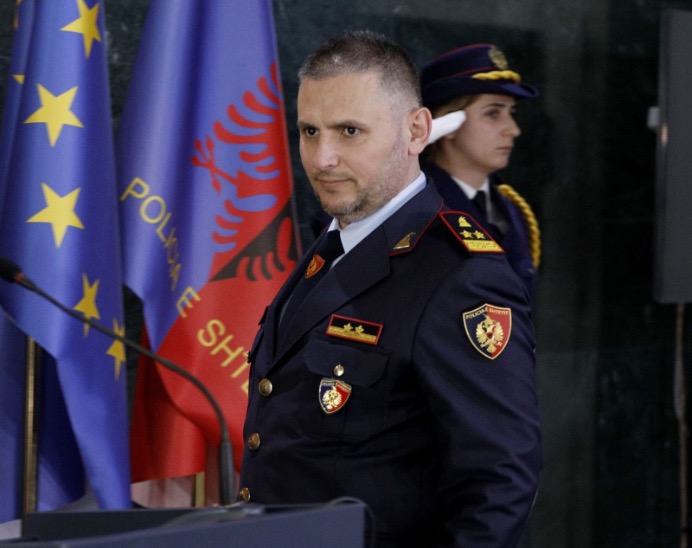
Five years after the protests of December 2020, the way the police intervened at the October rallies brought back questions about the preparedness of law enforcement and respect for standards in the management of protests. According to criminalistics expert Arben Hajdarmataj, the police were not prepared to deal with the recent protests. In his view, the lack of training and the involvement of units that are not specialised for this function affected the way the interventions unfolded.
“I do not think the State Police had been trained for the latest protest. In the absence of that preparation, I think that, to make up for this deficit, at a certain point the police forces descended into anarchy and used force disproportionately,” he says.
Hajdarmataj also objects to the involvement in protest management of police units which, according to him, have other functions and have not been specifically trained for interventions during assemblies.
“Other forces that do not have this task were also used to manage the protests. The rapid reaction force known as ‘Shqiponja’ [the Eagles] was also involved, which is not meant for managing protests and is not specifically trained for this,” he says.
Hajdarmataj also links this problem to the way people are recruited and promoted within the police. According to him, when a career is not based on merit and professional training, there is a risk that officers will feel untouchable and put obedience to orders above respect for the law.
“This leads those police officers to develop the idea that they are untouchable, that they are above the law and have no fear of it. Because someone who advances in their career on their own merit, who passes through every step of the career ladder, respects the law. They do not break it for any kind of order,” he says.
The expert also expresses scepticism about the independence of the Police Oversight Agency, questioning the way its heads are appointed and the influence of politics on its functioning.
“I am very sceptical about the functioning of AMP, because AMP was created as a political structure. The director of AMP is chosen by the minister, the minister by the prime minister, and so on. Only in cases that become public, when there is an outcry, might it take up the matter and make a referral to the prosecutor’s office,” says Hajdarmataj.
One of the promises that accompanied the discussion on modernising the police in the years after 2010 was to equip officers with body cameras. Around a decade ago, former Interior Minister Saimir Tahiri declared that every police officer in Tirana would be equipped with a camera, with the aim of increasing public trust and putting an end to abusive practices.
But in 2020, when Klodian Rasha was shot dead, the two officers who chased him were not equipped with body cameras.
Six years later, cameras are back in the discussion on modernising the State Police. They are presented as an instrument for documenting interventions, increasing transparency and preventing abuses. But technology alone does not guarantee that a violation will be identified or that the person responsible will be held to account.
“Anything that would serve transparency is good in principle, but electronic cameras can be manipulated like everything else. So the solution requires the will to decriminalise, while cameras are being used as a tool that is good in principle but, in this case, serves propaganda,” says Hajdarmataj.
Concerns about the functioning of the police have not been raised only by lawyers and experts. In its 2026 progress report on Albania, the European Commission notes that the State Police remains vulnerable to corruption and that the integrity checks on officers have had limited impact.
The report also mentions the student protests of October 2026, during which there were violent incidents between protesters and police, damage to public and private property by protesters and allegations of excessive use of force by the authorities against protesters and journalists. The Commission called on the parties to engage in dialogue.
Civil society and human rights organisations also called for independent investigations after the protests. In a joint statement published on 23 October 2026, 45 organisations raised concerns about reports of excessive use of force, ill-treatment, arbitrary detentions and violations of the rights of children and journalists.
In Albania, however, the institutional response to the October protests focused mainly on the violence against officers and the damage to institutions. At a hearing, the General Director of the State Police, Skënder Hita, presented photographs of injured officers and spoke about the attacks on them. In that presentation, according to the material reviewed by the newsroom, the allegations of violence against protesters were not given comparable treatment.
In his public appearances, Prime Minister Edi Rama condemned the violence against institutions and officers. He mentioned the allegations of excessive use of force by the police after the publication of the European Commission’s report, when he said that they should be examined seriously.
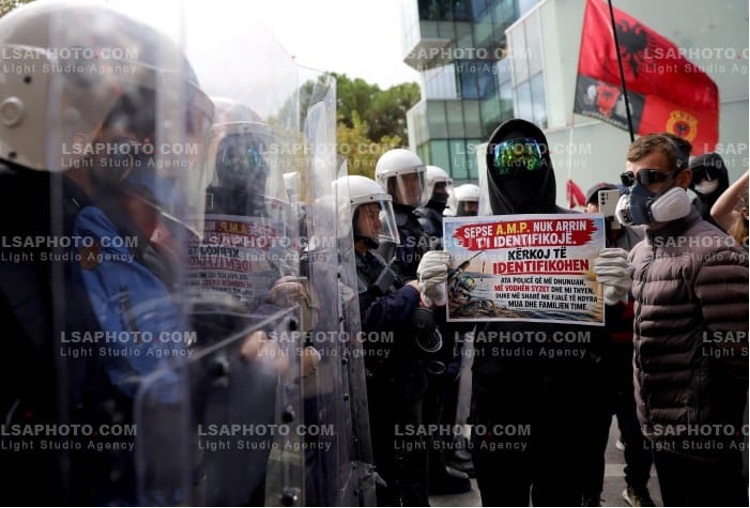
A nameless uniform, violence without a perpetrator
Credits: LSA
In the October protests, concerns about the actions of the police were not limited to the use of physical force. Of the 319 people arrested between 13 and 31 October, the court found 62 arrests to be unlawful.
An investigation by Shteg.org into the attack on Police Commissariat No. 2 raised questions about the evidence against 29 people who had been arrested. For some of them, there was no material evidence linking them directly to the acts of violence, while the suspicions rested mainly on police duty reports and on their presence near the scene. The court found these 29 arrests lawful, but stressed the importance of individualising responsibility and of the proportionality of the security measures.
The court identified the same problems in the protests of December 2020 as well, when mass detentions and problems with the treatment of minors were reported. Six years on, the limits of police intervention and procedural safeguards are once again part of the debate.
After the killing of Klodian Rasha, the officer who fired was criminally convicted, while the Interior Minister resigned. But criminal liability for the shooting was not extended to a wider chain of officers.
Official documents show that the other police officer who chased Rasha returned to duty two weeks after the event.
For Hajdarmataj, the way political and institutional leaders react to allegations of violations can affect the culture of accountability within the police.
“It is not only the lack of punitive measures, which certainly plays a part; it is the government itself, starting with the central government, that has emboldened the police to behave in this way. The arrogance of the police towards citizens is the result of a government mindset that has been passed on to the Ministry of the Interior and down to police officers,” he says.
In December 2020, a 25-year-old lost his life to a police service weapon. In October 2026, a 21-year-old was seen on video being struck with a shield, and his family reported serious injuries. In both cases, the clashes were accompanied by the use of force, contested arrests and reports of violence against citizens.
Between the two periods lie reforms, institutional changes, promises of body cameras, training and oversight mechanisms. But the complaint figures do not show how many cases were punished, the institutions have not made available all the information requested, and experts raise questions about the independence of police oversight.
__________________________
This text was produced within the framework of the MediaLit project, implemented by the Centre for Civic Education (CGO) in partnership with the Helsinki Committee for Human Rights in Serbia, the Helsinki Committee for Human Rights in North Macedonia, the Tirana Centre for Journalistic Excellence in Albania, and the Atlantic Initiative in Bosnia and Herzegovina. The project is funded by the European Union and co-financed by the Ministry of Regional and Investment Development and Cooperation with NGOs of the Government of Montenegro. The content of this text is the sole responsibility of the author and does not necessarily reflect the views of CGO, the partner organisations, the European Union, or the Ministry.

The post In The Shadow of the Police Uniform appeared first on Tirana Times.