Tirana Times, June 29, 2026 – For years, the debate on European Union enlargement has been dominated by the presumed costs of admitting new members: institutional complexity, financial burdens, political resistance and the challenges of integrating countries still undergoing democratic and rule of law reforms. Yet a more strategic question is now gaining ground in European policy circles: what is the cost of not enlarging?
This was the central theme of a conference held in Brussels by the Albanian Institute for International Studies, AIIS, marking the conclusion of its long-term project, “Mission Possible: Enlargement and Restoring the Union’s Credibility and Global Influence.” The project, implemented with the support of the Open Society Institute and the Open Society Foundations as part of the “Next Mile” program, sought to shift the focus from the traditional debate over the costs of enlargement to the strategic, political and security costs of non enlargement.
Held at the premises of Albania’s Mission to the European Union, the event brought together diplomats, experts, representatives and advisers from COELA, officials from candidate countries’ missions in Brussels and analysts from leading European think tanks. The setting itself carried symbolic weight. Albania’s Mission to the EU is expected to move soon to a larger and more multifunctional space, reflecting the country’s growing engagement as one of the frontrunners in accession negotiations.
Participants were welcomed by H.E. Albana Dautllari, Head of Albania’s Mission to the EU, who emphasized the need for stronger cooperation between diplomats and experts in making the case for enlargement. She underlined that credible, accurate and engaging narratives are essential in shaping public opinion both in candidate countries and in EU member states.
The discussion highlighted that enlargement should no longer be viewed only as a policy designed to transform aspiring members. It is also a strategic investment in the European Union’s own security, resilience, prosperity and global credibility. In a geopolitical environment marked by war in Ukraine, growing great power competition and increasing instability in Europe’s neighborhood, leaving the Western Balkans in prolonged uncertainty is not a neutral option. It creates vulnerabilities that other actors can exploit.
In his opening remarks, AIIS Chairman Dr. Albert Rakipi focused on three key dimensions of the enlargement debate: the need to strengthen local ownership of reforms in the Western Balkans, the importance of moving beyond mythical expectations about Europeanization, and the strategic value of enlargement for the European Union itself.
Rakipi argued that public support for EU membership, although overwhelmingly high in Albania and the wider region, does not automatically produce democratic understanding or ownership of the accession process. “EU integration is not a magical solution that can simply come from Brussels,” he said. “It is a process of social, economic, institutional, and political transformation.”

According to Rakipi, the real transformative power of enlargement lies not only in the final act of membership, but in the process that leads to it. “It is not EU membership alone that transforms our countries and societies,” he said. “What transforms them is the process itself: building a functioning state, a stronger economy, higher standards, the rule of law, accountable institutions, and the capacity to provide basic public goods to citizens.”
Rakipi also placed enlargement in a broader cultural and geopolitical context. He noted that in the imagination of many Balkan societies, Europe often appears as something distant and almost unreachable. “Europe as a myth will continue to exist,” he said. “And like all myths, it is somehow unreachable. But Europe as a reality is possible.”
This distinction, he argued, is central to understanding the challenge of enlargement today. The question is not whether the Western Balkans belong to Europe geographically or historically, but whether their states, institutions and societies can be transformed into functioning European realities. “The real question is this: how do we make the Albanian village, the Serbian village, the Macedonian village, the Kosovar village, and the Georgian village European villages?” Rakipi said.
Professor Sokol Lleshi of New York University Tirana examined the potential consequences for the Western Balkans if the integration process stalls or fails. He addressed the risks across several dimensions, including security, economic development, governance and the rule of law. A prolonged or failed accession process, he argued, would weaken reform incentives, deepen public frustration and leave the region more exposed to instability and external influence.
Marat Szpala of the Polish Academy of Sciences focused on the costs of non enlargement for the European Union itself. He argued that the EU is already paying a price for keeping the Western Balkans in a state of prolonged uncertainty. Without a credible enlargement perspective, the Union must invest in additional security arrangements while facing growing geopolitical vulnerabilities in its immediate neighborhood.
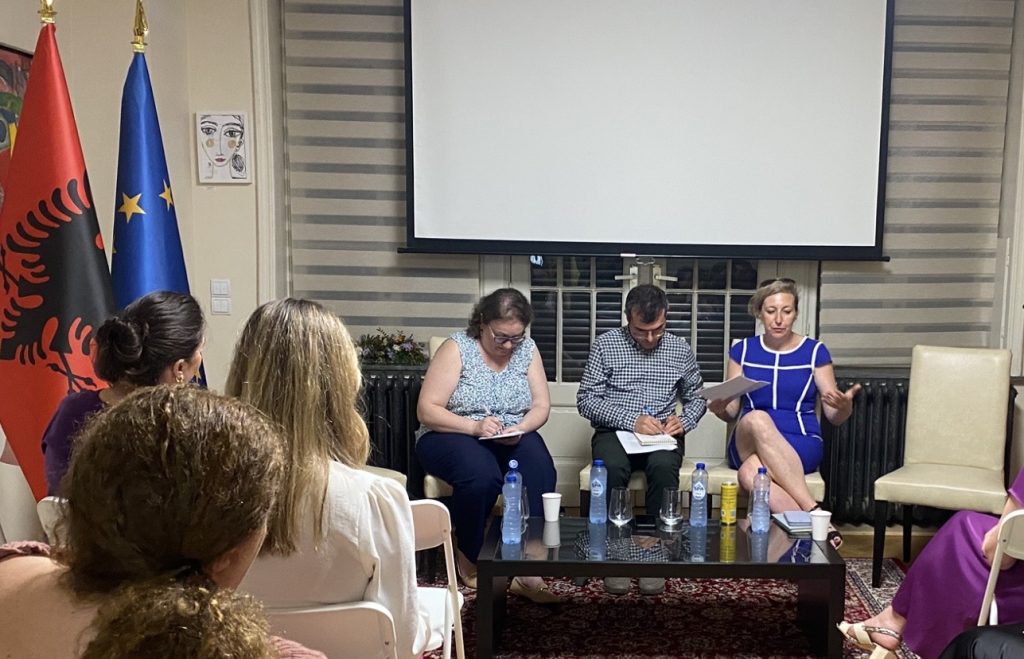
The event also brought together three interrelated perspectives: the costs of non enlargement for the Western Balkans, for the countries of the former Association Trio, and for the European Union. This broader approach reflected a changing understanding of enlargement as a pan European strategic question rather than a narrow regional policy.
Rakipi underlined that, from a security and geopolitical perspective, the Western Balkans should no longer be seen primarily as a problem for Europe, but as a potential partner. “For a long time, Europe viewed the Balkans primarily as a security concern,” he said. “That equation is no longer relevant. From a security and geopolitical perspective, the Balkans should now be seen as a security partner.”
The central message emerging from the Brussels discussion was clear: enlargement remains one of the European Union’s most successful policies, but its credibility depends on whether it can still deliver. For candidate countries, the accession process remains a crucial anchor for democratic transformation, rule of law reforms and institutional modernization. For the EU, enlargement is increasingly linked to power projection, regional stability and its ability to act as a credible geopolitical actor.
The cost of non enlargement, therefore, is not abstract. It can be measured in weakened reform momentum, declining trust, security gaps, democratic backsliding and the loss of European influence in a strategically important region. As Rakipi put it, “Enlargement is not a favor granted to candidate countries. It is a strategic investment in Europe’s own stability, security, and credibility.”
The question, therefore, is no longer only whether the Western Balkans are ready for the European Union. It is also whether the European Union is ready to recognize that its own future security, influence and credibility depend on completing the enlargement process.
The post The Cost of Non Enlargement: Why the EU Cannot Afford to Leave the Western Balkans Behind appeared first on Tirana Times.